Is the Bible True?
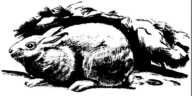
DO HARES REALLY
CHEW THE CUD?
by Louis A. Turk, B.A., M.Div., Ph.D.
How could the digestive process of the lowly hare
become the object of an important theological discussion? The Bible
says that the hare chews the cud, but a recent humanist book claims that
the Bible is in error on this point. Furthermore,
this humanist book claims that since the Bible contains this error, it
is not the Word of God and cannot be taken seriously on any other points
either. These are serious charges.
On the other hand, if the humanists be wrong
on this point, perhaps it is they whom we should not take seriously on
any other points either.
So let’s study the hare closely to see if the Bible is indeed wrong,
or if it is these atheistic religious humanists who are wrong.
The Bible Says Hares Chew the Cud
These religious humanists are right about one thing:
the Bible does teach that hares chew the cud.
Nevertheless these ye shall not eat of them that chew the cud, or of
them that divide the cloven hoof; as the camel, and the hare, and the coney:
for they chew the cud, but divide not the hoof; therefore they are unclean
unto you (Deut 14.7).
And the hare, because he cheweth the cud, but divideth not the hoof;
he is unclean unto you (Lev 11.6).
These two passages of Scripture very clearly state that the children of
Israel were not to eat the hare because the hare chews the cud, but does
not have a divided hoof. (Some people believe that not all hares
can be considered rabbits. However, everyone seems to agree that
all rabbits are hares. So, for this article the two terms will be
used interchangeably.) It is correct to say that the Bible does,
indeed, teach that rabbits (hares) chew the cud.
Humanists Claim Hares Don’t Chew the Cud
It cannot be said that all humanists teach that hares
do not chew the cud, for we would have to question every humanist in the
world to ascertain that. However, it can truthfully be said that
some very well known humanists do so say. Rod
L. Evans and Irwin M. Berent have written
a book entitled Fundamentalism: Hazard and Heartbreaks
which has a forward by Steve Allen and
an introduction by Isaac Asimov. Asimov
was one of the signers of Humanist Manifesto II and has written
many books opposing Christianity and teaching humanism, and was till his
recent death president of the American Humanist Association, so we can
safely conclude that he would not have written the introduction to this
book unless it was in accord with his humanistic views. This
book is a collection of many of the excuses atheists have given over the
years for rejecting God, the Bible, and Jesus Christ.
Most of these excuses were proven erroneous years ago shortly after they
were given, and only dishonest people would continue to use them.
However, there was one excuse listed in this book
that was new (at least to me). On page 86 of their book, Evans and
Berent state:
Evidently the belief in perfect Biblical accuracy is also a misconception.
For Leviticus 11:6 states that "the hare...chews the cud...", which is
a demonstrably false statement. (Rod L. Evans; Irwin M. Berent, Fundamentalism:
Hazard and Heartbreaks, foreword by Steve Allen; introduction by Isaac
Asimov (La Salle, Illinois: Open Court Publishing Company, 1988), 86)
Since Evans and Berent make this statement publicly
in a book devoted totally to discrediting people "who believe that the
Bible is infallible" (Ibid., xix.), it behooves us to see if these two
atheistic religious humanists really base everything on conclusions reached
by the scientific method, as they claim. Or
are they simply spouting off some of the "profane and vain babblings, and
oppositions of science falsely so called" we are warned about in 1 Tim
6.20?
What Are the Facts?
Surprisingly little is known about hares. Until relatively recent
times, few scientific studies were made of them. R.M. Lockley, a
distinguished British biologist and field naturalist, is among the foremost
hare experts. His book, The Private Life of the Rabbit: An Account
of the life and History and Social Behavior of the Wild Rabbit (New
York, Macmillan Publishing Co., Inc., 1964), details his research and provides
a authoritative answer to our question.
Lockley spent most of his life studying rabbits. As a child he
raised rabbits. When he was twenty he obtained the lease to "240-acre
Skokholm island, five miles off the entrance to Milforn Haven" (Ibid.,
14). His intention was to kill off the wild rabbit population on
this island so that he could raise a more valuable strain of rabbit which
had fur resembling that of the chinchillas. He preformed many experiments
to try to control the wild rabbit population on this island. Says
Lockley,
Indirectly my experience in studying rabbit control methods at Skokholm
led to an invitation from the Nature Conservancy to investigate on their
behalf the progress of myxomatosis, when it broke out in England in 1953;
and subsequently from 1954 to 1959 I was able to carry out a life-history
study of the rabbit on my small estate of Orielton in Pembrokeshire (Ibid.,
16).
Lockley and his helpers built a special observatory where they could observe
wild rabbits up close, both above ground and in their burrows, without
disturbing the rabbits. From his careful and systematic observations
in this unique observatory, Lockley became one of the foremost authorities
on rabbits.
Chapter 10 of Lockley’s book is entitled "Reingestion." He begins
this chapter by quoting Leviticus chapter 11, as we did at the beginning
of this article. He then reports that rabbits do little underground
except rest, sleep, and preen themselves. However, there is one exception
to this relative lack of activity while underground.
So long as we could watch the rabbits underground we had an ideal opportunity
to study the phenomena of coprophagy or reingestion.
The fact that rabbits...and hares ‘chew the cud’ was recorded
in the Bible. It is mentioned in Leviticus, Chapter 11, as written
under the title of this chapter. Also (the Jewish law of clean and
unclean meats) in Deuteronomy XIV....Later writers, even authorities on
both wild and domestic rabbits, have seldom referred to this phenomenon.
In general, textbooks on rabbit physiology and management ignore the subject,
not because of its lowly theme but because the authors apparently were
ignorant of it. Since its recent rediscovery it has been called ‘reingestion,’
a suitable term implying that it is a form of re-eating and redigestion
of food. (Ibid., 101-2)
Lockley goes on to explain that rabbits chew their cuds differently than
cows, goats or sheep, which regurgitate their food and rechew it.
The rabbit, instead, eats its own excrement (faecal pellets), and thus
redigests them. Usually this occurs during the daytime underground
as the rabbit is resting. Occasionally this was observed above ground,
but
could easily be overlooked by the casual observer. A swift bending
of the head during which the long ears almost touched the ground between
the hind legs, then the rabbit’s head would come up and the jaws work for
a few seconds as the pellet was swallowed and the tongue licked around
inside the mouth afterwards. In the rabbit there is a curious infolding
of the lower lips over the space between the incisor and molar teeth which
protects and hides the tongue. The observer could not see the faeces
because of the masking action and the closed mouth. (Ibid., 103)
We are forced to conclude that simple faith in God’s Word would have resulted
long ago in scientists looking more specifically, and therefore seeing,
rabbits chewing their cud. But unbelief kept them blinded to the
facts.
But Do Hares Really ”Chew” the Cud?
Lockley reports that researchers Mervyn Griffiths and David Davies in Australia
have demonstrated that each soft pellet is separate and by the time
it reaches the rectum is enveloped in a strong membrane....These soft pellets
pass down to the rectum in glossy clusters. They are swallowed whole
by the rabbit, that is, without breaking the enveloping membranes.
This in itself is a remarkable feat, as, although the rabbit (under observation
in the open as well as in our artificial burrow) sometimes appears to chew
this faecal ‘cud’ after collecting it from the anus, with movements of
the jaws varying in time from one to over one hundred seconds, Griffiths
and Davies assert that the soft pellets are found whole in the stomach
and therefore must be swallowed whole. The movement of the jaws may
therefore be solely a swallowing, followed by a cleaning action of the
tongue, during which saliva is ingested along with the soft pellets and
must aid in the digestive process.
So, are the pellets (cud) chewed or not? It is perhaps impossible
to ever observe what is actually going on inside the rabbit’s mouth as
it appears to chew the cud. I would suggest that since the Bible
was right about the rabbit having a cud, it is also right about the rabbit
chewing the cud. Perhaps the chewing is gentle enough so as to not
break the membrane, but rough enough to crush its contents so as to make
redigestion easier. This certainly seems possible as Lockley says
that "the membrane is quite tough" (Ibid., 106), and would account for
the fact that the rabbit spends from "one to over 100 seconds" doing something
with its jaws that certainly appears to be chewing after taking the cud
into its mouth. One thing for certain: God’s word has certainly proven
to be more accurate than the speculation of unbelievers. Is it not
significant that unbelieving "scientists" have not known about a rabbit’s
cud for thousands of years even though the fact of it is recorded in the
oldest book on earth? It should be obvious to all that the Bible
is no ordinary book to be set aside lightly.
Some Important Conclusions
Having proved humanists wrong on yet another point in which they contest
the Bible, how can we trust anything they say any longer? All my
life I have been examining the claims of unbelievers that there are errors
in the Bible. In every case to date, after careful examination the
Bible has proven to be correct, and the men that questioned it have proven
to be in error. God’s Word has without exception proven itself fully
qualified to correct men, while men have shown themselves to be totally
unqualified to correct God’s Word. The wise man will agree with the
Bible: "Let God be true, but every man a liar" (Rom 3.4).
Perhaps the most important lesson to be learned from this study about
hares chewing the cud is this: had we gone to the library at an earlier
point in history we may not have been able to find any books supporting
the Bible position concerning this matter. However, the Bible would
still have been true, and the men who disputed it would have been wrong.
Sometimes direct research has to be done to confirm the accuracy of a questioned
Bible verse, but the Bible is always proven to be true in the end.
The cud of a hare is just one example of proof that the so-called "science"
of humanism is not actually science at all, but is mere philosophy—unproven
opinions of men. A true scientist reports only what he observes.
But no one has ever observed life come from dead matter, or a non-human
give birth to a human. No one has ever observed an animal of one
kind give birth to an animal of a different kind. These are the presuppositions
of the theory of evolution. The fact that humanists claim such unscientific
theories to be scientific shows that they are unable to look at anything
without bias. The truth is they approach all aspects of life with
the fanatical belief that "the only absolute is that there are no absolutes."
They have espoused such a silly idea because God claims to be absolute
authority, and the Bible claims to be the absolute truth, and so they must
reject both God and the Bible to keep from feeling guilty when they purposely
break God’s laws which are recorded in the Bible. Therefore, rejection
of absolutes is inseperable from atheism.
The moment a person rejects absolutes that person declares war on God
and Christianity, for if God is not absolute in holiness as the Bible of
Christianity teaches, then there must be a better morality then God’s,
in which case the Christian teaching that Christian morality is perfect
would be a great hinderance to progress and therefore a great evil.
As Sir Julius Huxley, one of Humanism’s most famous champions, states in
The Humanist Frame,
Humanism...will have nothing to do with Absolutes, including absolute
truth, absolute morality, absolute perfection and absolute authority....any
belief in supernatural creators, rulers, or influencers of natural or human
process introduces an irreparable split into the universe, and prevents
us from grasping its real unity. Any belief in Absolutes, whether the absolute
validity of moral commandments, of authority of revelation, of inner certitude,
or of divine inspiration, erects a formidable barrier against progress
and the possibility of improvement, moral, rational, or religious.
(Julian Huxley, The Humanist Frame [New York: Harper & Brothers,
1961], 14 and 40.)
This is why humanists spend so much time, energy and resources opposing
Christianity.
Unfortunately, it is impossible to reason with a humanist. One
cannot have a logical discussion with a person who believes one cannot
be absolutely sure about anything, and that nothing matters except winning
the argument. Since he is not absolutely sure that what he himself
believes is true, he possesses no solid, unchanging values. Thus
it is impossible to find a mutually accepted foundation upon which to base
logic so as to be able to persuade him of anything. The moment he
sees that his challenger’s argument is valid, he changes his belief so
as to make his challengers efforts to communicate with him fruitless.
A humanist can justify any evil behavior—even murder, robbery, rape,
or sodomy—with a giddy "nothing is absolutely wrong." Having no clear
concept of right and wrong, such a person constantly changes positions,
and lies, sincerely believing that even lying is not absolutely wrong.
Such a person therefore cannot be of high integrity or character, for he
can never be trusted to tell the truth or to keep his promises.
Consider how stupid and illogical this foundational ideological belief
of humanism actually is. If there are no absolutes, then it cannot
be absolutely true that there are no absolutes. And if it is not
absolutely true that there are no absolutes, then it must be absolutely
false that the there are no absolutes. And if it be absolutely false
that there are no absolutes, then it must be absolutely true that there
are absolutes.
Obviously then when a person rejects absolutes he is intentionally closing
his eyes to the light. He can’t see because he won’t see. This
is why rejecting God and the Bible makes it impossible for a person to
ever find truth.
The fear of the LORD is the beginning of knowledge: but fools despise
wisdom and instruction. (Prov 1.7)
To the law and to the testimony: if they speak not according to this
word, it is because there is no light in them. (Is 8.20)
Beware lest any man spoil you through philosophy and vain deceit, after
the rudiments of the world, and not after Christ. For in him dwelleth
all the fulness of the Godhead bodily (Col 2.8-9).
Dr. Henry M. Morris, in his book The Long War Against God: the History
and Impact of the Creation/Evolution Conflict (Grand Rapids, Michigan:
Baker Book House, 1989), page 344, says concerning humanism and Isaac Asimov:
That humanism is merely a more genteel term for atheism is confirmed
by the current president of the American Humanist Association, Dr. Isaac
Asimov, who is also probably the most prolific writer in the whole world
of science, having authored approximately three hundred books, covering
every scientific field. He says: "I am an atheist, out and out.
It took me a long time to say it. I’ve been an atheist for years
and years, but somehow I felt it was intellectually unrespectable to say
one was an atheist, because it assumed knowledge that one didn’t have.
Somehow it was better to say one was a humanist or an agnostic. I
finally decided that I’m a creature of emotion as well as of reason.
Emotionally, I am an atheist. I don’t have the evidence to prove
that God doesn’t exist, but I so strongly suspect he doesn’t that I don’t
want to waste my time."
One very significant admission appears in this statement of atheistic
faith by Asimov. Not only does he acknowledge that humanism is essentially
the same as atheism, but also that atheism is nothing but an emotional
belief. In spite of the fact that he is one of the most knowledgeable
scientists in the world, having written books on just about every branch
of science in existence, he recognizes that he has no "evidence to prove
God doesn’t exist." If Asimov has no evidence against God, we can
be sure nobody does! He believes in humanism/atheism simply because
that is what he wants to believe! The same is true for every other
devotee of this man-centered religion. Yet they commonly deride creationism
because it requires faith! One naturally thinks of Psalms 53.12:
"The fool hath said in his heart, There is no God."
One is also reminded of Rom 1.28: "...as they did not like to retain God
in their knowledge, God gave them over to a reprobate mind." Webster’s
New World Dictionary, Second Edition, defines reprobate as "depraved, corrupt,
unprincipled; rejected by God; excluded from salvation and lost in sin."
Such is the humanist mind—a high price to pay for closing ones eyes to
the plain facts of all true science.
To learn how you can be rescued from such a terrible condition, read
"Ye Must Be Born Again."
(C) Copyright 1994 by Louis A. Turk. All rights reserved. You may
reprint this article, provided you do not edit it in any way without the
author's consent, and provided this paragraph is printed at the end of
the article. Other publication requires advance permission of the
author.
Louis A. Turk, B.A., M.Div., Ph.D.
www.Eternal-Salvation.Org
The website dedicated to the study of eternal life.
ETERNAL LIFE IS NOT TEMPORARY LIFE!